Wood & Deck Care · 4 min read
Ipe & Wood Deck Refinishing in South Florida: What to Know and When to Do It
Ipe is one of the hardest, most premium decking woods in the world, and South Florida is one of the hardest places to keep it looking that way. The right product, the right technique, and the three months a year when refinishing actually works.
By John 'The Greek' Painting · Published · South Florida
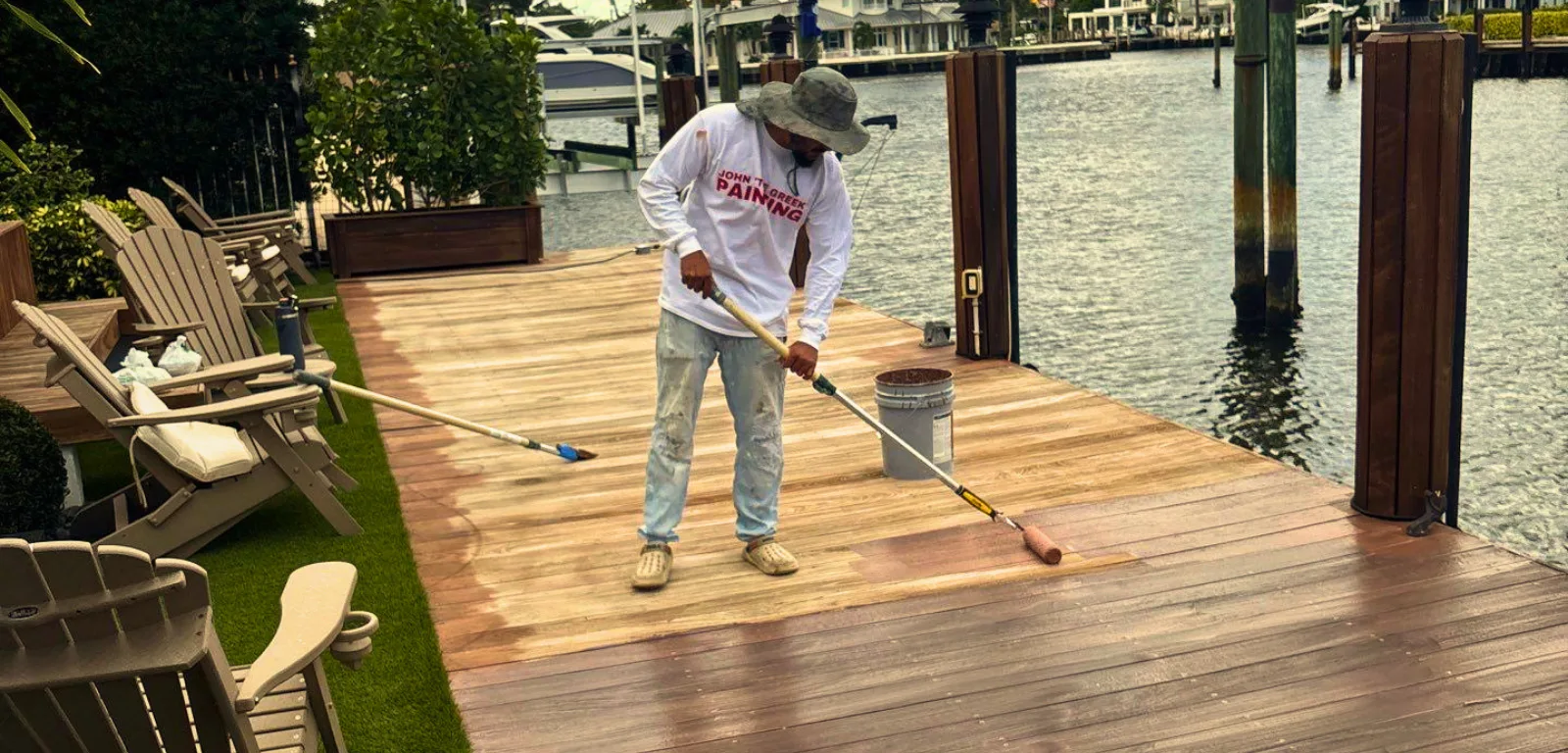
TL;DR: The short version: Ipe and other dense hardwoods need penetrating oil, never film-forming stain, applied with minimal sanding. In coastal South Florida, plan on professional refinishing every 12 to 18 months, and schedule it for March, April, or October. Above 90°F the oil cannot penetrate properly, and above 70% humidity it cannot cure.
If you own an Ipe deck or dock in South Florida, two things determine whether it stays a rich chocolate brown or fades to weathered gray with cracked, patchy finish: using a penetrating oil instead of a film-forming stain, and refinishing on South Florida's schedule, not the national one. Coastal decks here need professional refinishing every 12 to 18 months, roughly twice as often as inland, and the work should be done in March, April, or October, the windows when heat and humidity allow the oil to penetrate and cure. Ipe (Brazilian hardwood) is disproportionately common on this region's high-end and waterfront homes, and it is spectacular decking, among the hardest wood commercially available. But that same density is exactly why the standard deck-staining playbook fails on it. Here is what every Ipe owner needs to know.
Why does Ipe need a different approach than regular decking?
Everything unusual about maintaining Ipe comes from its density. Pressure-treated pine soaks up almost any product you put on it. Ipe barely absorbs anything, so products and techniques designed for soft wood fail on it in predictable ways.
- 3,680 lbf — Janka hardness: Ipe measures 3,680 lbf on the Janka hardness scale, roughly five times harder than pressure-treated pine. It resists rot, insects, and wear for decades, and resists absorbing finishes just as stubbornly.
- 12–18 mo — Coastal refinish cycle: Coastal South Florida decks need professional refinishing every 12 to 18 months, versus every 2 to 3 years inland. Salt air, UV, and humidity work the finish from every direction.
- 2× — Florida vs. national pace: Standard wood decks across Florida need refinishing every 1 to 2 years due to UV intensity and year-round humidity, significantly faster than the national average. The sun here simply does more damage per season.
Penetrating oil or film-forming stain: which one for Ipe?
Penetrating oil, every time. This is the single most expensive mistake we see on hardwood decks, so it is worth understanding why.
Film-forming stains and sealers work by building a layer on top of the wood. On dense Ipe that film cannot key into the surface, so it sits on top, and South Florida sun and moisture get under it within months. It then fails the ugly way: peeling, flaking, and blotching, and the only fix is stripping the entire film off a wood that fights sanding, an expensive job that often leaves the deck looking worse than bare. Penetrating hardwood oils work with the wood instead: they soak into the surface fibers, replenish the natural oils UV burns off, and restore the deep color. When a penetrating oil wears, it simply fades evenly, and the next application renews it. No film, so nothing to peel or strip.
When is the best time to refinish a deck in South Florida?
March, April, and October. Those three months are not a preference, they are chemistry. Hardwood oils need moderate temperatures to penetrate and moderate humidity to cure, and South Florida spends most of the year outside both ranges.
Above roughly 90°F, deck boards in direct sun get hot enough that the oil flashes off at the surface instead of soaking in, leaving a sticky, uneven finish with poor protection. Above roughly 70% humidity, the oil cannot cure properly, staying tacky for days and holding every leaf and footprint. From May through September, South Florida's wet season delivers both problems at once, plus a daily afternoon storm that will ruin an uncured finish outright. March and April bring the year's driest, most moderate stretch, and October closes the wet season with falling humidity while still warm enough for good flow. If your deck is due in July, the professional answer is to prep now and finish in October.
- Monthly: Rinse the deck with fresh water, especially waterfront decks and docks, to clear salt, organic debris, and mildew spores before they work into the grain.
- Every 12–18 mo: Professional clean, brighten, and re-oil for coastal Ipe decks. Inland decks can typically stretch to every 2 to 3 years.
- Mar / Apr / Oct: Book refinishing inside these windows. Heat above 90°F blocks oil penetration and humidity above 70% prevents curing, which rules out most of the summer.
- After storms: Inspect fasteners, board ends, and dock hardware after major storms. Ipe rarely suffers, but movement and lifted fasteners open paths for water to stand.
What does a professional Ipe refinish involve?
Done right, refinishing Ipe is a restoration process matched to the wood's density. Done wrong, it is a pressure washer and a film stain, and the deck pays for it for years.
- Clean and brighten the wood. A dedicated hardwood cleaner lifts dirt, mildew, and the gray oxidized surface layer, followed by a wood brightener that restores the tannin balance and reopens the surface so it can accept oil. Gentle pressure only; aggressive pressure washing furs the grain on any wood.
- Products
- Hardwood cleaner + brightener
- Not
- High-pressure washing
- Sand minimally, only where needed. Ipe is dense enough that heavy sanding burnishes the surface, effectively polishing it closed so oil cannot penetrate at all. We spot-sand raised grain and stains with light grits and leave sound wood alone. This is the step where hardwood experience matters most.
- Approach
- Spot-sand, light grit
- Risk if overdone
- Oil won't absorb
- Apply penetrating hardwood oil. A penetrating oil formulated for dense hardwoods goes on in thin, controlled coats, working with the board length. On Ipe, thin is correct: the wood takes what it can absorb and no more.
- Type
- Penetrating hardwood oil
- Coats
- Thin, worked in
- Wipe back the excess. Whatever oil the dense surface has not absorbed within the product's window gets wiped back by hand. On Ipe this step is not optional; excess oil left on the surface stays tacky, collects dirt, and dries shiny and uneven.
- Timing
- Within the absorption window
- Result
- Uniform matte-to-satin finish
Ipe doesn't forgive shortcuts. The wood outlasts every mistake made on it, and it shows every one until someone fixes it properly.
John The Greek Painting — wood finishing crew
What does Ipe refinishing cost in South Florida?
Professional Ipe refinishing projects in coastal South Florida typically range from $4,000 to $6,000 and up, depending on the deck's size, condition, railing and stair detail, and whether a dock is included. That reflects the labor-intensive process the wood demands: hand-applied oil, hand wipe-back, and careful prep instead of a spray-and-go film coating.
Context matters for that number. Ipe decking itself is a premium investment, often several times the installed cost of pressure-treated wood, and a properly maintained Ipe deck lasts for decades in a climate that destroys lesser decks in ten years. The 12-to-18-month refinishing cycle is what protects that underlying investment. Letting the finish lapse costs little at first, since the wood itself endures, but recovering a deeply grayed, neglected deck back to furniture-grade color costs considerably more than maintaining one on schedule.
Frequently asked questions
How often should a deck be refinished in Florida?
Coastal South Florida decks need professional refinishing every 12 to 18 months, whether Ipe or standard wood, because salt air, extreme UV, and year-round humidity break finishes down from every direction. Inland Florida decks typically stretch to every 2 to 3 years. Standard wood decks across Florida broadly need refinishing every 1 to 2 years, which is significantly faster than the national average. The reliable tell on an oiled hardwood deck: when water stops beading and the color has flattened noticeably, the oil is spent and the wood is taking UV unprotected.
What is the best time of year to stain or oil a deck in Florida?
March, April, and October. Deck oils and stains need surface temperatures below about 90°F to penetrate properly and humidity below about 70% to cure, and those three months are when South Florida reliably delivers both. Summer refinishing tends to fail twice over: hot boards make the oil flash off at the surface instead of absorbing, and afternoon humidity and daily storms keep it from curing, leaving a tacky, blotchy finish. If your deck comes due mid-summer, the right move is to wait for October rather than apply a finish that will not bond.
Can I just let my Ipe deck turn gray?
Yes, and some owners deliberately choose the silvered look. Ipe is dense and rot-resistant enough that it will not decay just because the finish lapsed; the gray is a thin oxidized surface layer, not damage. The trade-offs are appearance and reversibility: the deck loses the chocolate-brown color that Ipe is prized for, the surface can develop light checking over years of unprotected UV, and bringing a deeply weathered deck back to full color takes an intensive clean, brighten, and re-oil restoration. Maintaining the oil on schedule is easier and cheaper than a rescue later.
Why did the stain on my hardwood deck peel?
Almost certainly because a film-forming stain or sealer was used on dense hardwood. Film-formers need to key into the wood's surface to hold, and Ipe and similar hardwoods are too dense to allow it, so the film sits on top until sun and moisture break the weak bond. It then peels and flakes in patches, and the fix requires stripping the failed film, a slow, costly job on a wood that resists sanding. The lasting solution is switching to a penetrating hardwood oil after the strip: it soaks in rather than sitting on top, so there is no film to peel again.
How much does it cost to refinish an Ipe deck in South Florida?
Coastal South Florida Ipe refinishing projects generally run $4,000 to $6,000 and up. The main cost drivers are square footage, how weathered the wood is (a maintained deck needs less restoration than a gray one), the amount of railing, stair, and bench detail, and whether docks or elevated structures are included. Hardwood work is priced above standard deck staining because the process is hand-intensive: cleaning and brightening, careful minimal sanding, oil application, and hand wipe-back. We quote from an on-site assessment of the wood's actual condition.
Should I pressure wash my Ipe deck?
Only with low pressure and the right technique, and never as a substitute for proper cleaning products. High-pressure washing furs the grain of any wood and can gouge softer spring growth even in dense hardwood, leaving a fuzzy surface that grays faster and takes oil unevenly. The professional approach is a hardwood cleaner and brightener applied with gentle rinsing, which removes dirt, mildew, and oxidation chemically rather than by force. Between refinishes, a monthly fresh-water rinse with a garden hose is all the washing a South Florida Ipe deck should need.