Waterproofing & Moisture · 4 min read
Moisture Testing Before Painting: Why Smart Florida Homeowners Test Their Walls First
Paint that bubbles or peels within a year or two almost always failed before the first coat went on. A moisture diagnostic finds the water hiding inside your walls so the new paint actually bonds and lasts.
By John 'The Greek' Painting · Published · South Florida
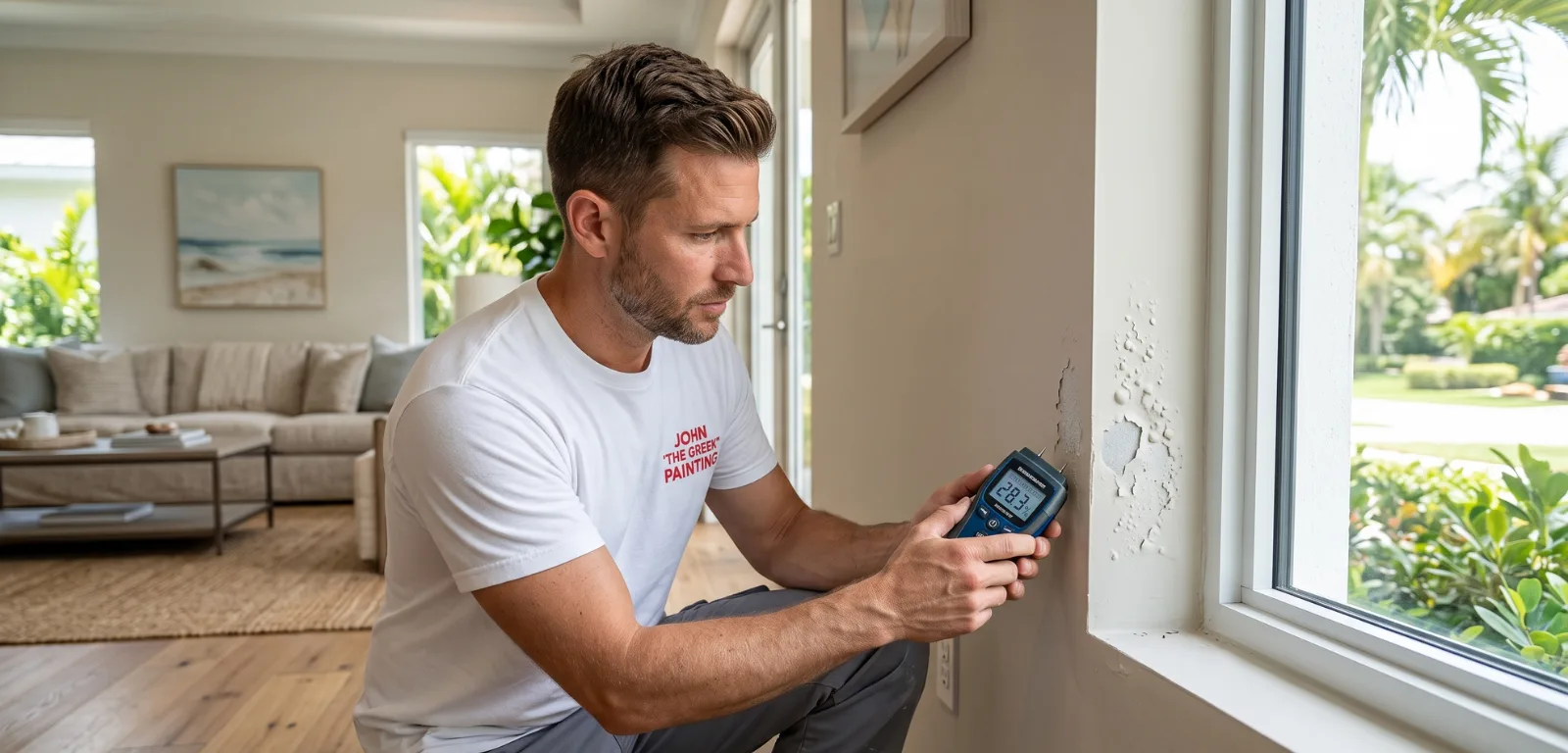
TL;DR: The short version: paint will not bond to a wet wall. Before we recommend or apply any coating, we test the substrate with calibrated digital moisture meters and ASTM-standard hydrostatic pressure testing. Masonry needs to read below roughly 5% and wood below 15%, or the new paint fails no matter how good it is.
A homeowner near the Intracoastal called us about paint bubbling and peeling on a wall that had been repainted less than two years earlier. Before quoting a repaint, we did something the previous contractor never did: we tested the wall. The moisture meter read nearly triple the safe level for masonry. Water was coming in through hairline stucco cracks and a failed window seal, and no coat of paint was ever going to hold there. That test changed the entire job, and it saved the homeowner from paying for the same failure twice. In South Florida's humidity, testing your walls for moisture before painting is not optional. It is the difference between a paint job that lasts its full life and one that starts blistering by the second summer.
What is a professional moisture diagnostic?
A moisture diagnostic, sometimes called water testing, is a dedicated upfront service that maps out exactly what is happening inside your walls before any coating is recommended or applied. We treat waterproofing as a science, so instead of guessing from what a wall looks like on the surface, we measure it.
The diagnostic combines calibrated digital moisture meter readings across the walls, ASTM-standard hydrostatic pressure testing to see how the substrate handles water under pressure, and a surface porosity evaluation to confirm the wall will actually accept a new membrane or coating. The result is concrete data on your property's health, not an eyeball estimate.
- 5% — Masonry threshold: Concrete, block, and stucco generally need to test below about 5% moisture content before a coating can bond safely. Above that, water vapor pushes the new paint off from behind.
- 15% — Wood threshold: Wood substrates need to read below roughly 15% moisture. Paint applied over wetter wood traps the water inside, which leads to peeling, rot, and mold under the finish.
- 60+ in — Rain per year: South Florida takes on more than 60 inches of rain annually plus year-round humidity, so walls here hold hidden moisture far more often than homeowners expect.
Why does paint fail when you skip the test?
Paint and waterproofing membranes bond by gripping a dry, stable surface. Trapped moisture breaks that bond in three ways, and all three are common here.
- Blistering and bubbling: sun heats the wall, moisture inside turns to vapor, and the vapor pushes the paint film off in bubbles, often within the first year.
- Peeling and flaking: the bond never fully forms on a damp substrate, so sheets of paint let go, usually starting at edges, corners, and around windows.
- Mold behind the finish: sealing moisture inside a wall gives mold a dark, damp home. By the time it shows through, the problem is much bigger than paint.
The frustrating part is that a wall can look completely dry and still fail every one of these ways. Moisture travels inside block and stucco from a roof edge, a planter bed, a failed sealant joint, or a sprinkler line, and it surfaces somewhere else entirely. That is why we test instead of assuming, and why a repaint quote without a moisture reading is a guess.
How does the moisture diagnostic work?
The full diagnostic is a field-testing visit, not a quick scan at the front door. Here is what we do on site.
- Walk the property and map the risk zones. We inspect the full exterior (and interior walls where paint is failing) and note the usual suspects: stucco cracks, stained areas, efflorescence, failed caulk joints, roof-to-wall connections, and irrigation overspray. This tells us where to concentrate the instrument testing.
- Covers
- Exterior + problem walls
- Output
- Test-zone map
- Take calibrated moisture meter readings. Using calibrated digital moisture meters, we measure moisture content across each zone and compare against the critical thresholds: roughly 5% for masonry and 15% for wood. Multiple readings per wall separate a surface-damp wall that just needs time from one with an active water source.
- Masonry limit
- ≈ 5%
- Wood limit
- ≈ 15%
- Run hydrostatic pressure testing. Where the readings or the history call for it, we run ASTM-standard hydrostatic pressure testing to verify how the substrate behaves when water is driven against it, the way wind-driven rain hits a wall in a summer storm. This exposes intrusion paths that stay invisible on a sunny day.
- Standard
- ASTM field methods
- Simulates
- Wind-driven rain
- Evaluate surface porosity. A membrane or coating only works if the substrate absorbs and holds it correctly. We evaluate porosity so we can specify the right primer and product for your exact wall instead of a one-size-fits-all system.
- Decides
- Primer + coating spec
- Report findings and fix the source first. You get the readings and what they mean in plain language. If we find active moisture, we identify the source and the repair (sealant, crack repair, waterproofing, drainage) that has to happen before paint. Only when the wall tests dry do we recommend a coating system, which is why our repaints hold.
- You receive
- Data + repair plan
- Paint starts
- Only after walls test dry
A repaint quote without a moisture reading is a guess. We test first, so you pay to fix the problem once.
John The Greek Painting — field testing standard
When should you order a moisture diagnostic?
Some situations make testing a requirement, not just a smart habit. If any of these sound familiar, test before anyone opens a paint can.
- Paint is bubbling, blistering, or peeling, especially on a wall repainted in the last few years.
- You have had any water intrusion: a roof leak, a plumbing leak, window leaks, or storm flooding.
- You see efflorescence (white chalky mineral deposits) on stucco, block, or concrete.
- Interior walls show water stains, damp patches after rain, or a musty smell in certain rooms.
- You are planning a full repaint on a coastal or older home, where hidden moisture is most common.
Frequently asked questions
How do professionals check walls for moisture before painting?
We use calibrated digital moisture meters to measure the actual moisture content inside the substrate, not just surface dampness. Readings are compared against critical thresholds, roughly 5% for masonry and 15% for wood. Where the readings or the wall's history warrant it, we add ASTM-standard hydrostatic pressure testing to reveal how the wall behaves under wind-driven rain, plus a porosity evaluation to confirm the surface will accept a coating. A visual inspection alone cannot do this, because block and stucco can look perfectly dry while holding damaging moisture inside.
Why does paint peel so fast in humid climates like South Florida?
Humidity and rain keep feeding moisture into walls, and moisture is the number one cause of paint failure. When water sits inside a wall, sun exposure turns it to vapor that pushes the paint film off from behind, causing bubbles, blisters, and peeling sheets. South Florida makes it worse with 60+ inches of annual rain, salt air near the coast, and intense heat cycles. Paint applied over a wall that was never tested and never dried out can start failing in under two years, no matter how premium the paint itself is.
Can I test my walls for moisture myself?
Consumer pin-type moisture meters exist and can flag an obviously wet spot, which is useful. The limits are calibration and interpretation. Hardware-store meters drift, read only a shallow depth, and give numbers without context, and they cannot tell you whether the moisture is residual or fed by an active source. A professional diagnostic uses calibrated instruments, tests under pressure the way storms actually hit a wall, and most importantly identifies where the water is coming from, which is the part that determines the repair.
What happens if the moisture test finds a problem?
First, you get the data: where the readings are high and what the likely source is, such as stucco cracks, failed sealant, a roof edge, or irrigation spray. Then the source gets fixed, which may mean crack repair, re-caulking, waterproofing, or drainage corrections, and the wall is given time to dry down below the safe threshold. Only then do we recommend a coating system matched to your substrate. It can add time up front, but it is dramatically cheaper than paying for a repaint that fails and then fixing the leak anyway.
Does a moisture diagnostic cost extra?
We offer the moisture diagnostic and substrate testing as a dedicated, upfront service, and we will scope it for your property when you contact us. Think of the cost against the alternative: a full exterior repaint in South Florida is a five-figure investment, and painting over hidden moisture can cut its life in half or worse, while also inviting mold and structural damage. Concrete data on your walls before that investment is some of the cheapest insurance a homeowner can buy.