Waterproofing & Moisture · 4 min read
When Does Your South Florida Home Need Waterproofing? Signs, Timelines & What to Expect
Most homeowners learn their stucco needed waterproofing only after water shows up inside a wall. These are the early signs, the 5–7 year timeline, and what a professional waterproofing job actually looks like.
By John 'The Greek' Painting · Published · South Florida
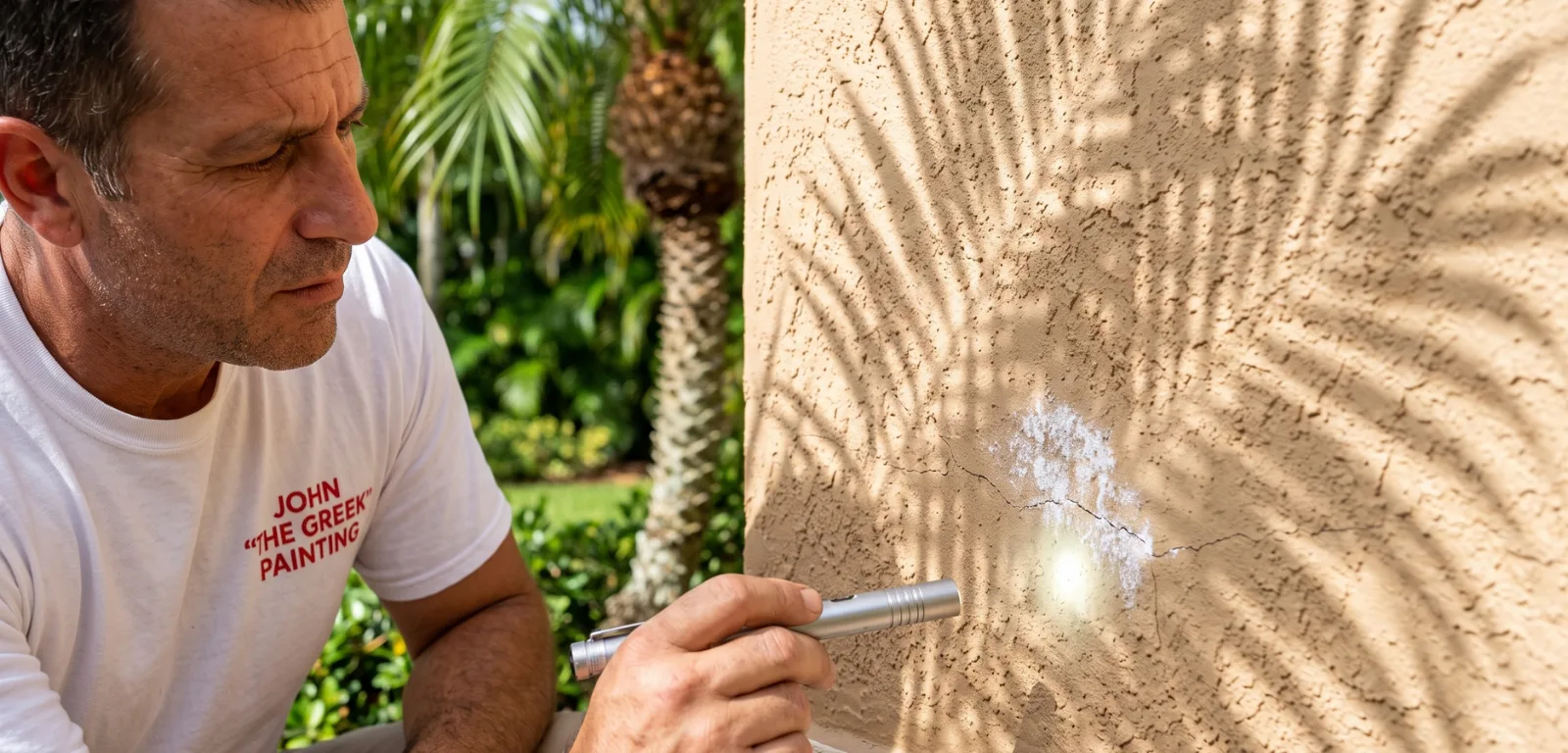
TL;DR: The short version: exterior stucco and masonry in South Florida need waterproofing reapplied every 5 to 7 years. Hairline cracks, efflorescence (white chalky deposits), soft or hollow-sounding stucco, and stains after rain mean the current protection has already failed and water is getting in.
If your South Florida home's exterior stucco or masonry has not been waterproofed in the last 5 to 7 years, it almost certainly needs it, and the signs are usually visible before water ever shows up inside. Hairline cracks, white chalky streaks, soft spots in the stucco, and dark staining after storms all mean the wall's protective barrier has broken down. This region takes on more than 60 inches of rain a year, most of it in a six-month wet season of daily wind-driven storms. Stucco and concrete block are porous materials; without an intact waterproof coating, they absorb that water like a sponge. Here is how to self-diagnose your exterior, what each sign means, and what to expect when you bring in a professional.
Why do South Florida homes need waterproofing at all?
Stucco and concrete block are the dominant construction here, and both are porous. Waterproofing is the sacrificial barrier that keeps 60+ inches of annual rain on the outside of that porous material. The barrier wears out well before the wall does, which is why it has to be renewed on a schedule.
- 60+ in — Rain per year: South Florida receives more than 60 inches of rainfall annually, much of it as wind-driven summer storms that push water sideways into walls, not just down them.
- 5–7yr — Reapplication cycle: Exterior waterproof coatings on stucco and masonry break down under UV and rain and need to be reapplied every 5 to 7 years. Most homeowners have never been told this.
- 75%+ — Average humidity: Year-round humidity keeps walls from ever fully drying out on their own, so once water gets behind a failed barrier it tends to stay and spread.
What are the signs your home needs waterproofing?
Walk your exterior after a good rain and look for these. Any one of them means the barrier is compromised; two or more mean water is already moving through the wall.
- Hairline cracks in stucco: even cracks too thin for a credit card are direct water pathways during driving rain. They concentrate around windows, doors, and band lines.
- Efflorescence: white, chalky mineral deposits on stucco, block, or concrete. This is water passing through the wall and leaving dissolved minerals behind as it evaporates, which is proof of moisture movement, not just a cosmetic issue.
- Soft or hollow-sounding stucco: press or gently tap the wall. Spots that feel spongy or sound hollow mean water has gotten behind the stucco and is breaking its bond with the block.
- Dark patches or staining that linger after rain: a healthy waterproofed wall sheds water and dries evenly. Sections that stay dark for hours are absorbing.
- Bubbling or peeling paint low on walls: moisture wicking up from planters, grade, or ponding areas pushes coatings off from behind.
- Musty smell, damp spots, or stains on interior walls: by this stage water has crossed the entire wall assembly. Move quickly.
What happens if you put it off?
Water intrusion is progressive. What starts as a cosmetic annoyance follows a predictable path toward structural repair, and each stage costs roughly an order of magnitude more than the one before it.
First the coating fails quietly and the wall starts absorbing. Then finishes fail visibly: paint peels, stucco stains, efflorescence blooms. Next, water reaches the interior, damaging drywall, baseboards, and flooring, and feeding mold in the wall cavity. In the final stage, moisture reaches the structure itself: wood framing rots, and in concrete block and reinforced concrete the embedded steel rusts and expands, cracking and spalling the concrete around it. A waterproofing job costs a fraction of a repaint; interior mold remediation and spalling repair cost multiples of one.
Every waterproofing call we get either comes 5 years in, or 10 years too late. The first group pays for a coating. The second pays for construction.
John The Greek Painting — 49 years serving South Florida
How often should each check happen?
Waterproofing works on a calendar, not on symptoms. By the time symptoms appear the barrier has usually been gone for a while. This is the schedule we recommend for homes in Miami, Fort Lauderdale, and Palm Beach.
- 1×/yr: Walk the full exterior after a heavy rain. Look for lingering dark patches, new cracks, efflorescence, and peeling paint, especially around windows and at the base of walls.
- After storms: After any major storm or hurricane, inspect sealant joints, roof-to-wall connections, and previously repaired cracks. Wind-driven rain finds new openings.
- Every 2–3 yr: Have sealant and caulk joints around windows, doors, and penetrations inspected and renewed. Caulk fails years before coatings do.
- Every 5–7 yr: Reapply exterior waterproofing on stucco and masonry. Pairing it with a scheduled repaint is the most cost-effective way, since prep and access are shared.
What should you expect from a professional waterproofing job?
A legitimate waterproofing job starts with measurement, not a pressure washer. Here is the sequence we follow.
- Moisture diagnostic first: we test the walls with calibrated moisture meters and hydrostatic pressure testing to confirm what is wet, why, and whether the substrate is ready to accept a membrane.
- Source repairs: cracks are routed and filled with elastomeric sealants, failed caulk joints are cut out and replaced, and soft stucco is repaired before anything is coated.
- Surface preparation: cleaning and priming matched to the wall's porosity, so the membrane actually bonds instead of sitting on chalk and salt.
- Waterproof coating system: an elastomeric waterproofing membrane applied at the manufacturer's specified thickness. Elastomeric coatings stretch, so they bridge future hairline cracks instead of splitting with them.
- Documentation: you should know what was applied, at what spread rate, and when the 5–7 year clock starts again.
Frequently asked questions
How often should stucco be waterproofed in Florida?
Every 5 to 7 years for exterior stucco and masonry in South Florida. UV exposure, 60+ inches of annual rain, and constant humidity break down waterproof coatings on that cycle regardless of how the wall looks from the street. Coastal homes sit at the short end of the range because salt air accelerates coating breakdown. The most economical approach is to pair waterproofing with your scheduled exterior repaint, since surface preparation, access, and mobilization are shared between the two jobs.
How do I know if my house needs waterproofing?
Walk the exterior after a rain and look for the six signs: hairline cracks in the stucco, efflorescence (white chalky mineral streaks), soft or hollow-sounding stucco spots, dark patches that stay damp for hours, bubbling or peeling paint near the base of walls, and any interior dampness or musty smell. Also check the calendar: if you cannot remember the last time the exterior was waterproofed, or it has been more than 7 years, assume the barrier is gone even if the wall still looks fine.
Is exterior paint the same as waterproofing?
No, and the difference matters. Standard exterior paint is a decorative and protective finish, but it is not engineered to stop water penetration through porous masonry. Waterproofing uses elastomeric membrane coatings applied at several times the thickness of paint. They remain flexible, stretch across hairline cracks as the wall moves, and are rated to resist wind-driven rain. A quality repaint over a failed substrate will not fix water intrusion. The right system for most South Florida stucco homes is waterproofing and finish coats working together.
What is the white chalky stuff on my stucco wall?
That is efflorescence, and it is one of the most useful early warnings a wall can give you. It forms when water enters the stucco or block, dissolves the natural mineral salts inside, and carries them to the surface as it evaporates, leaving the white residue behind. The deposits themselves wipe off, but the message does not: water is passing through your wall. Cleaning the stains without renewing the waterproofing treats the symptom and leaves the cause, so treat efflorescence as the signal to have the wall tested.
Can you waterproof over existing paint?
Sometimes, and testing tells us when. If the existing coating is well bonded, not chalking heavily, and the wall tests dry, an elastomeric waterproofing system can often be applied over it after cleaning and priming. If the existing paint is peeling, heavily chalked, or the wall shows active moisture, coating over it just buries the problem, so failed areas need to be stripped and repaired first. This is exactly why we run a moisture diagnostic and porosity evaluation before quoting, so the system is built on a surface that can hold it.