Coastal & Salt Air · 4 min read
Electrostatic Painting in South Florida: The Premium Finish for Metal Fences, Gates & Railings
Salt air eats standard paint jobs on metal. Electrostatic painting uses electrical charge to wrap paint around fences, gates, and railings in a uniform, factory-grade coat, and it is the finish we recommend for waterfront and high-end properties.
By John 'The Greek' Painting · Published · South Florida
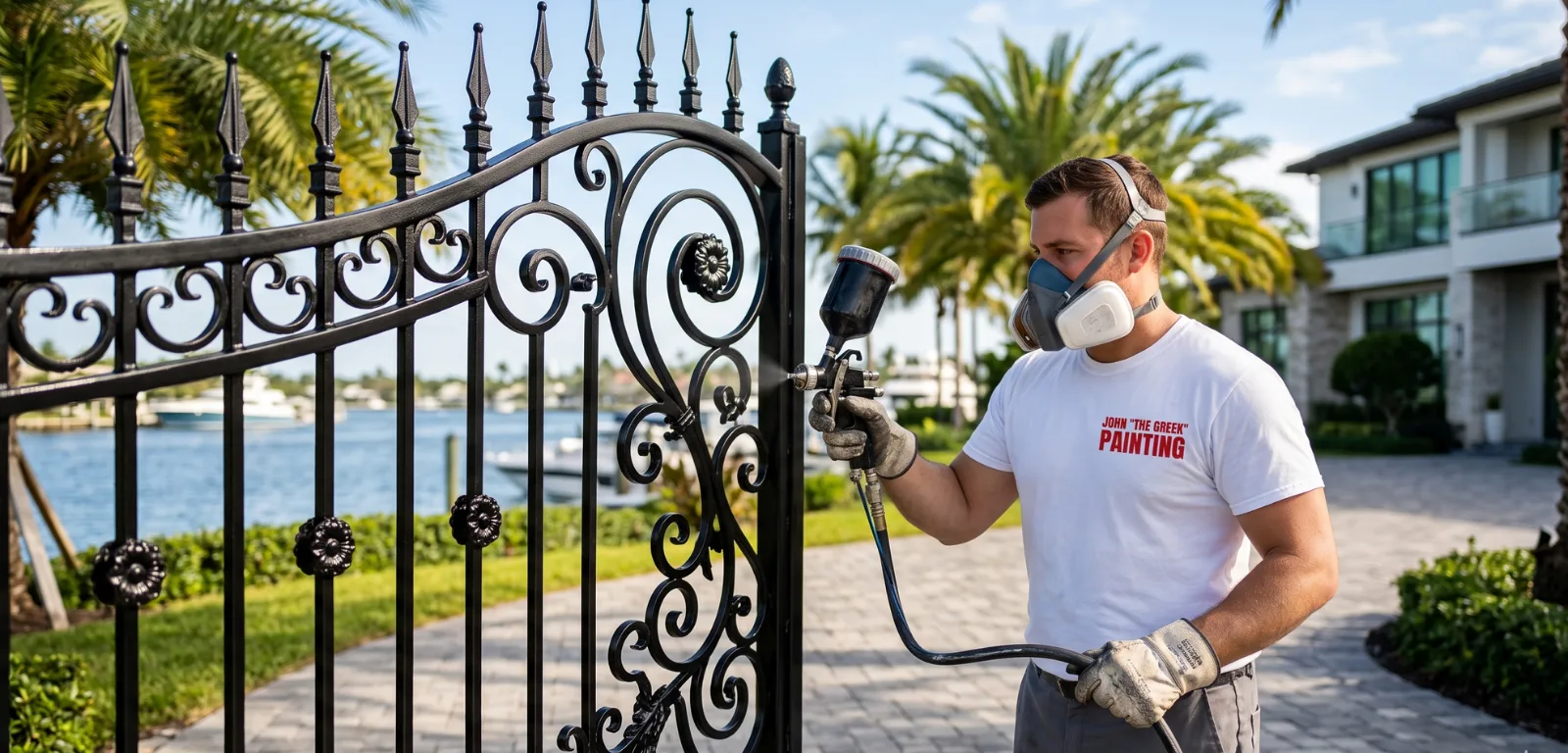
TL;DR: The short version: electrostatic painting gives paint particles an electrical charge so they are physically attracted to grounded metal, wrapping around bars, edges, and backs in one uniform coat. On South Florida metal fences, gates, and railings it delivers a smooth, factory-like finish with far better corrosion resistance than brush or roller. It is a premium service, with coating materials that run about triple the cost of standard paint, and for waterfront and high-end properties it is worth every dollar.
Electrostatic painting is a technique that electrically charges paint as it leaves the spray gun while the metal being painted is grounded, so the paint is literally pulled onto the surface and wraps around it, the same principle factories use to finish appliances and car bodies. For South Florida homeowners and property managers with metal fences, gates, railings, and equipment, it solves a specific problem: salt air and year-round humidity oxidize metal relentlessly, and conventional brush or roller finishes fail fast here. An electrostatic finish bonds tightly and uniformly to the metal, leaving no brush marks, drips, or thin spots for corrosion to start in. It is one of our specialty services, and this guide explains how it works, where it makes sense, and what the premium buys you.
How does electrostatic painting work?
The physics is simple and it is what makes the finish so different from anything a brush can do. The spray equipment gives each atomized paint particle a negative electrical charge. The metal fence, gate, or railing is grounded. Opposite charges attract, so the paint particles fly toward the metal and bond tightly to it, including surfaces the gun is not even pointing at.
That wrap-around effect is why electrostatic painting is the only on-site method that coats a fence bar's back side, inside edges, and welds as evenly as its face. Conventional spraying loses a large share of paint to the air as overspray; electrostatic application puts up to roughly 95% of the paint on the metal, which means a heavier, more uniform film and almost no overspray drifting onto your driveway, plants, or neighbor's car. The cured result looks and feels like a factory finish because it is applied the same way factories do it, just at your property.
- 95% — Transfer efficiency: Charged particles are attracted to the grounded metal, so up to about 95% of sprayed paint lands on the surface, versus a fraction of that with conventional spraying. More paint on the metal means a thicker, more protective film.
- 360° — Wrap-around coverage: The electrical attraction pulls paint around bars, edges, and hardware, coating backs and inside corners that brushes and standard sprayers leave thin. Corrosion starts in exactly those missed spots.
- 0 — Brush marks and drips: The finish levels into a smooth, uniform coat with no brush strokes, roller stipple, or runs. On decorative gates and railings the difference is visible from across the yard.
Why does salt air destroy standard paint on metal?
Coastal South Florida is one of the most corrosive environments in the country for exterior metal. Salt-laden air deposits chloride on every outdoor surface, and chloride accelerates oxidation wherever it can reach bare or thinly coated steel, iron, or aluminum.
Brush and roller finishes fail on metal here for a mechanical reason: they go on unevenly. Brush marks create ridges and valleys, edges and welds get thin coverage, and the back sides of bars often get missed entirely. Every thin spot and pinhole is an entry point where salt and moisture reach the metal, rust forms underneath, and the coating starts lifting from below. That is why a hand-painted fence near the water often shows rust bleed within a year or two. An electrostatic coat, uniform and bonded on every face of the metal, removes those entry points, which is where its corrosion resistance really comes from.
Which surfaces is electrostatic painting for?
If it is metal and it lives outdoors in South Florida, it is a candidate. These are the applications we handle most.
- Metal fences and gates: aluminum, wrought iron, and steel perimeter fencing, driveway gates, and pool fencing, where salt exposure is constant and appearance matters.
- Railings and balustrades: balcony rails, stair rails, and dock railings on waterfront homes and condo buildings.
- Entry doors, garage doors, and storefronts: metal doors and frames that need a smooth, durable, factory-look finish without being removed. On pre-1978 properties, prepping painted doors may also trigger EPA lead-safe renovation rules.
- Hurricane shutters and window frames: accordion shutters and metal frames that oxidize but cannot be practically re-coated any other way.
- Commercial equipment and fixtures: elevator doors, lockers, metal furniture, machinery housings, light poles, and mechanical equipment, refinished on site without shutting the property down.
What does premium actually mean here?
We are upfront about this: electrostatic painting is a premium service, in results and in price. The specialized coatings formulated for electrostatic application on metal run about three times the cost of standard paint materials, before the specialized equipment and trained applicators.
The value math still favors it for the right property. Replacing a custom aluminum or wrought iron fence runs many times the cost of refinishing it, and a failed standard paint job on coastal metal means repainting every couple of years, with rust doing structural damage in between. One properly executed electrostatic refinish protects the underlying investment for far longer and keeps a high-end property looking like one. Our electrostatic clients are mostly waterfront homeowners, estate properties, and commercial property managers, people who have already learned what the cheap version of this job costs over ten years.
You can replace a corroded fence, or you can protect it once with the finish it should have had from the factory.
John The Greek Painting — specialty services
How does it compare to brush, roller, or powder coating?
Three realistic options exist for refinishing exterior metal, and they are not interchangeable.
- Brush and roller: the budget option. Acceptable for low-visibility, low-exposure metal inland, but on coastal metal the uneven film means early rust bleed and a visible hand-painted look.
- Powder coating: excellent factory finish, but the part must be removed, stripped, and baked in an oven off site. For an installed fence, gate, or railing system, removal and reinstallation usually makes it impractical.
- Electrostatic painting: factory-style uniformity and adhesion, applied on site with the metal exactly where it is. For installed fences, gates, railings, shutters, and equipment in a salt-air environment, it is the option that combines finish quality with practicality.
Frequently asked questions
What is electrostatic painting and how is it different from regular spray painting?
Electrostatic painting electrically charges the paint particles while the metal surface is grounded, so the paint is attracted to the metal and wraps around it, bonding uniformly on faces, edges, and backs. Regular spraying relies on aim alone: a large share of the paint drifts away as overspray, and complex shapes like fence bars get uneven coverage. The electrostatic method puts up to about 95% of the paint on the surface in a smooth, factory-like film, with almost no overspray, which is why it is the standard for refinishing installed metal in place.
How do I protect a metal fence from rust in Florida?
Three things determine how long a metal fence survives South Florida salt air: surface preparation, coating quality, and coverage uniformity. Existing rust has to be mechanically removed and the metal treated with a rust-inhibitive primer, otherwise corrosion continues under any new paint. Then the coating needs to cover every face of the metal at even thickness, which is exactly what brush and roller cannot do on fencing and electrostatic application does inherently. Rinsing salt off the metal with fresh water a few times a year extends any finish considerably.
What is the best paint for metal gates near the ocean?
The best system, not just paint, is what matters on coastal metal. It starts with a rust-inhibitive primer over properly prepared metal, followed by a high-performance topcoat formulated for exterior metal, typically industrial-grade enamels or urethane coatings rather than ordinary exterior house paint. Applied electrostatically, these coatings bond in a uniform film without the thin spots where chloride starts corrosion. Those specialty materials cost roughly three times what standard paint does, which is a large part of why electrostatic work is priced as a premium service.
Does electrostatic painting work on aluminum fences?
Yes. Aluminum does not rust the way steel does, but in salt air it oxidizes, pits, and chalks, and factory finishes on aluminum fencing and railings fade and break down under South Florida UV. Electrostatic refinishing restores a uniform factory-look coat and seals the metal against further pitting. It works on aluminum, steel, wrought iron, and galvanized metal; the preparation and primer are matched to each. Since aluminum fencing is among the most common perimeter fencing on waterfront properties here, it is actually one of our most frequent electrostatic applications.
How long does an electrostatic paint finish last?
Substantially longer than brush or roller on the same metal, because failure on coastal metal starts at thin spots and misses, and electrostatic application eliminates most of them. Exact life depends on exposure: a gate a block from the ocean lives a harder life than one five miles inland. As a rule, expect years more service than a conventional repaint, with the finish keeping its gloss and color noticeably better. A fresh-water rinse of the metal a few times a year, more often on the oceanfront, is the single best thing an owner can do to extend it.
Can electrostatic painting be done on site without removing the fence or railing?
Yes, and that is one of its main advantages over powder coating, which requires removing the metal and baking it in an oven at a facility. Electrostatic equipment is portable: we ground the metal where it stands, and the charged spray does the rest. There is minimal overspray because the paint is attracted to the metal rather than drifting, so surrounding landscaping, pavers, and vehicles are far easier to protect than with conventional spraying. For commercial properties, that also means refinishing railings, doors, and equipment without shutting down operations.